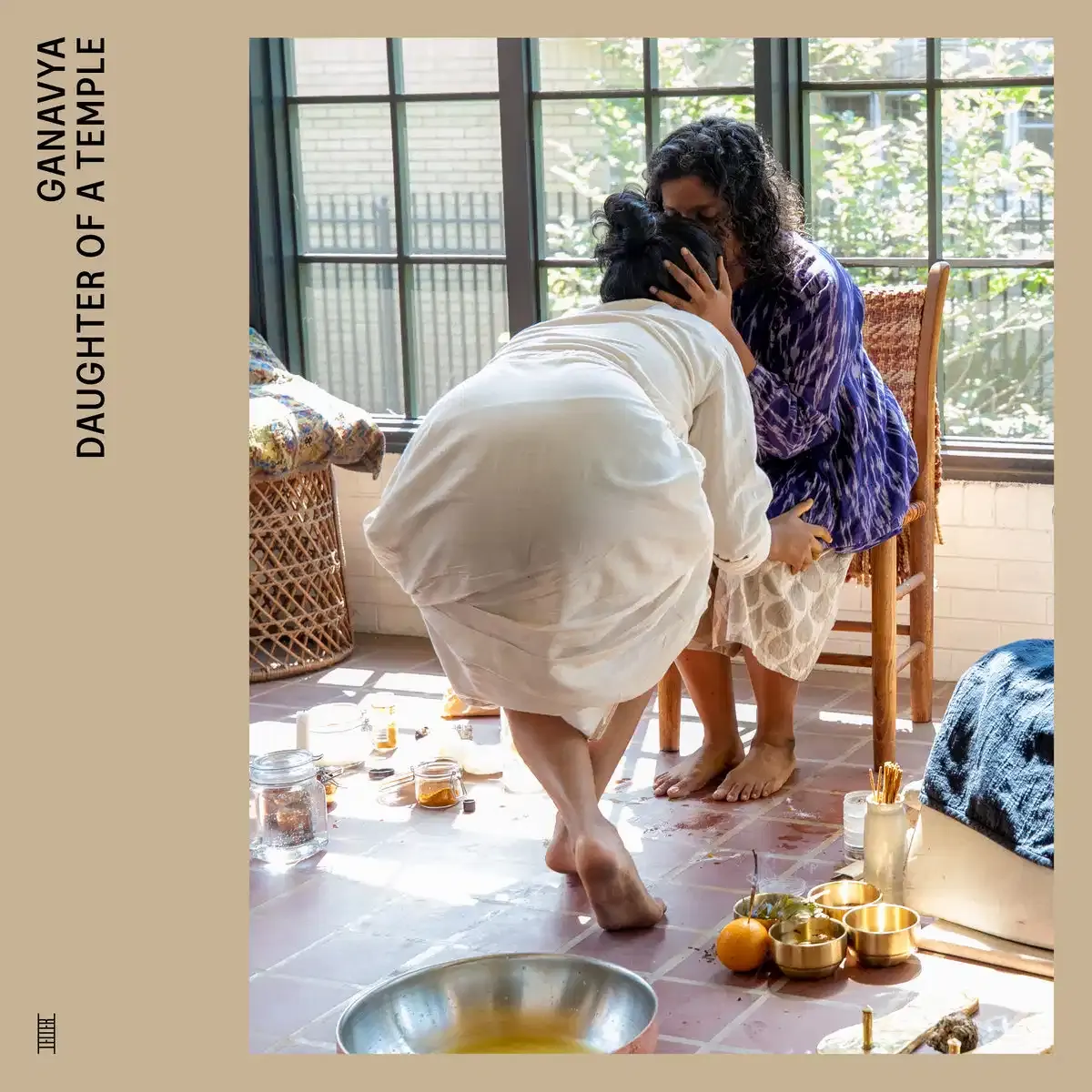
Daughter of a Temple – ganavya
Daughter of a Temple marks a turning point in ganavya’s body of work. More than a record, it is the result of a ritual gathering held in Houston, where over thirty artists were summoned to explore music as a collective spiritual practice.
Inspired by the teachings of Alice Coltrane and her concept of Turiyasangitananda, the project moves away from traditional structures to embrace a form of creation based on devotion, listening, and community.
Musically, the album inhabits a hybrid territory between spiritual jazz, contemporary improvisation, and South Asian traditions such as harikatha. The compositions unfold without hierarchies, where voice, instruments, and silence coexist as parts of the same flow.
The production—initially recorded by Ryan Renteria and later edited by Nils Frahm in Berlin—maintains an organic, almost ceremonial quality, where each piece feels as though it is emerging in real-time.
The album brings together an exceptional community of artists, including:
- Esperanza Spalding
- Vijay Iyer
- Shabaka Hutchings
- Immanuel Wilkins
- Peter Sellars
Each contributes a distinct dimension to a work built from collectivity rather than individual virtuosity.
The album functions as a continuous flow rather than a sequence of songs, but highlights include:
- A Love Chant: An opening that encapsulates the project's communal spirit.
- Om Supreme: A meditative expansion guided by Vijay Iyer’s piano.
- Journey In Satchitananda / Ghana Nila: A collective reinterpretation of spiritual motifs.
- A Love Supreme Parts 1–4: The emotional core of the record and an expanded homage to the spiritual jazz tradition.
In essence, Daughter of a Temple is an attempt to reconstruct the idea of community through music. A space where the individual dissolves into the collective and where artistic practice becomes a form of care.
More than an album, it is evidence that—as Wayne Shorter intuited—music has no beginning or end, only a shared present.