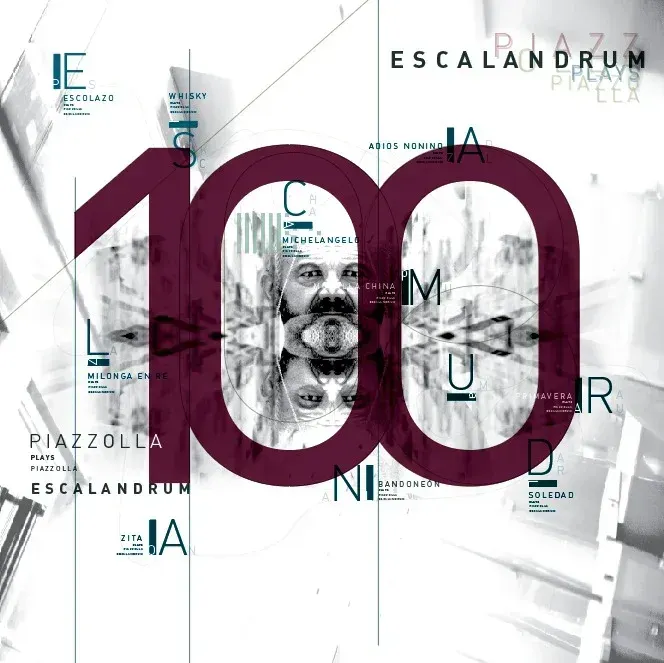
100 – Escalandrum
100 begins with a body of work that is instantly recognizable and carries it into a territory where memory ceases to be an obligation. Escalandrum returns to the music of Astor Piazzolla a decade after Piazzolla Plays Piazzolla, but from a different place: there is no longer a need to prove fidelity or justify its intersection with jazz. The compositions retain their identity while the sextet reshapes their internal tensions, shifts their accents, and finds new spaces for improvisation.
The lineup that drummer Daniel “Pipi” Piazzolla has maintained alongside Nicolás Guerschberg on piano, Mariano Sívori on double bass, Gustavo Musso on alto and soprano saxophones, Damián Fogiel on tenor saxophone, and Martín Pantyrer on baritone saxophone and bass clarinet draws upon a fundamental quality of these scores: their ability to remain open. On “Primavera Porteña” and “Soledad,” familiar melodies acquire a different sense of breath through a rhythm section that refuses to treat them as closed forms and a horn section that expands their harmonic range without dissolving the original drama.
That freedom becomes even more apparent in less frequently explored material such as “La Muralla China” and “Milonga en Re.” Guerschberg, responsible for the arrangements, preserves enough traces of Astor’s vocabulary for their origins never to disappear; around them, however, he creates spaces where each musician can alter the course of the piece. The written material ceases to function as a structure that must be preserved and becomes a meeting point between composition and intuition.
The album includes the introduction from a previously unreleased recording of Astor Piazzolla, captured at Estudios ION in Buenos Aires during the 1970s: a free bandoneon solo to which the sextet responds decades later. The gesture could easily have remained trapped in the emotion of the archive, but the opposite occurs. The ensemble plays around that voice without turning it into a relic; it listens, intervenes, and ultimately transforms a historical recording into an impossible conversation across time.
Recorded between Abbey Road and Estudios ION, 100 makes no attempt to update Astor Piazzolla or preserve him under glass. Escalandrum does something considerably more difficult: it acknowledges an inheritance, enters it with complete familiarity, and then allows itself to disobey it. The music remains alive precisely because it can still change.