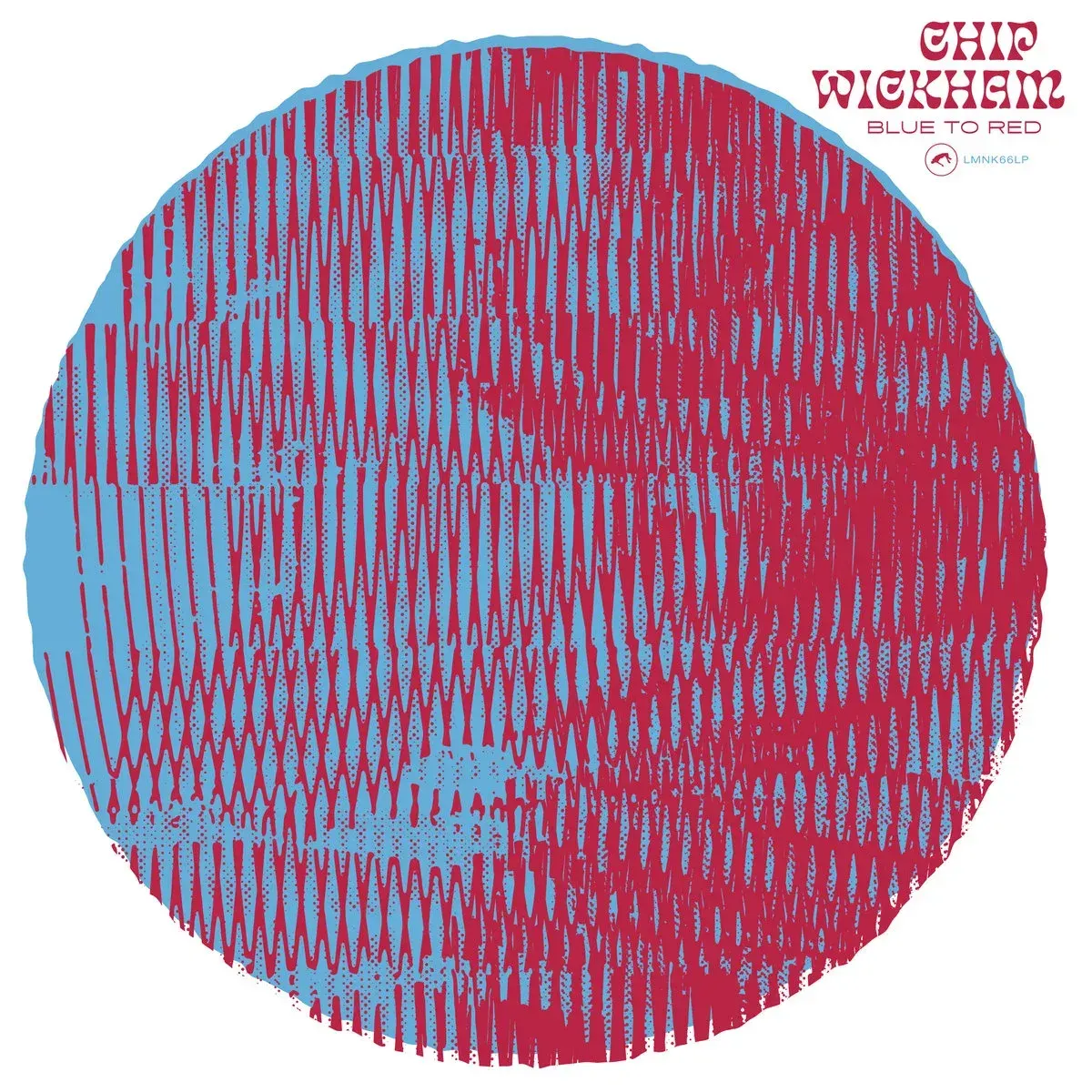
Blue to Red – Chip Wickham
Spiritual jazz has spent decades looking toward space in search of something that seems to exceed our own existence. On Blue to Red, Chip Wickham reverses that direction: he uses the cosmos to remind us that perhaps we should be paying closer attention to the planet we already have. Mars appears not as a promise of the future, but as a warning; it was once blue before becoming a red, lifeless world.
That idea runs through six compositions in which Wickham builds a language around flute, Rhodes, harp and percussion. Amanda Whiting is essential to that architecture: her harp arpeggios and shifting figures introduce a sense of light that remains in constant dialogue with the keyboards of Dan ‘JD 73’ Goldman, while Simon ‘Sneaky’ Houghton on double bass and cello, Jon Scott on drums and Rick Weedon on percussion sustain a motion that can be contemplative without ever becoming still.
“The Cosmos” takes this architecture to its most expansive form. An almost hypnotic bass line allows the Rhodes, harp and flute to slowly appear and recede, leaving enough room for silence to become part of the composition itself. Wickham seems to understand that evoking immensity does not require filling every space; it is enough to find the precise distance between sounds.
There is friction in Blue to Red as well. “Route One” compresses that spaciousness into an immediate groove and a melody that is difficult to shake from memory, while “Double Cross” unleashes the more physical side of Wickham. His flute stops floating and begins to attack, driven by a rhythm section that connects spiritual jazz with the club culture that also shaped his musical education.
The traces of Yusef Lateef and Alice Coltrane are perceptible, particularly in the treatment of flute and harp, but Blue to Red finds its identity when it stops looking toward its influences. Wickham’s warm, meticulous production absorbs those traditions into a sensibility shaped by hip-hop, electronic music and contemporary British jazz.
That is where the album’s central paradox becomes so effective. Blue to Red sounds like an interplanetary exploration, yet its message remains insistently terrestrial. Wickham looks toward space only to point back at us: before asking what lies beyond, perhaps we should learn how to preserve the extraordinary blue planet beneath our feet.