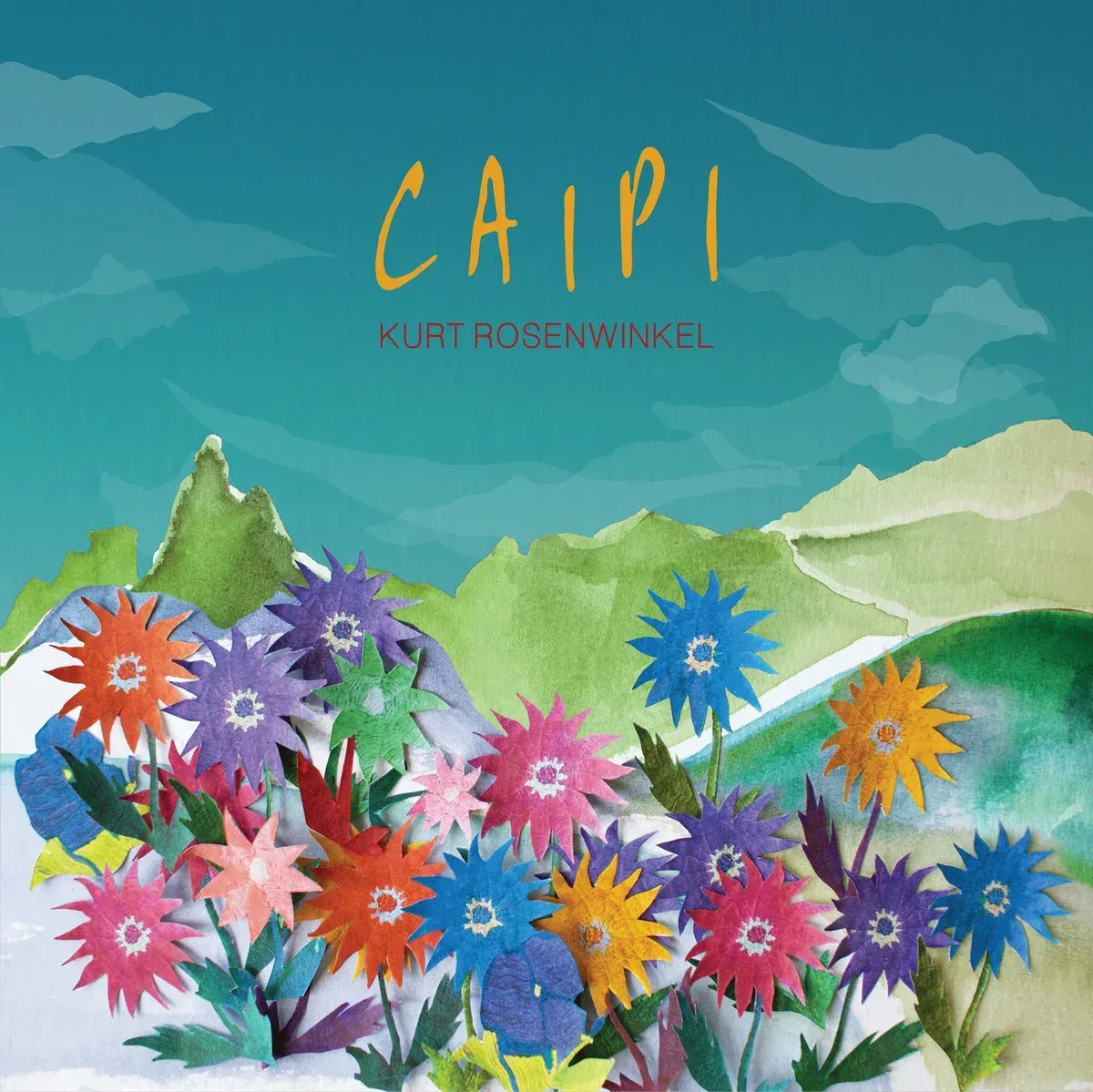
Caipi – Kurt Rosenwinkel
For much of Caipi, Kurt Rosenwinkel’s guitar could easily take center stage, yet the opposite happens. After decades of developing one of the most recognizable sounds in contemporary guitar, he spreads his identity across voice, piano, bass, drums, synthesizers, percussion, and guitars, creating songs in which who plays each instrument matters less than the way they all end up painting the same landscape.
“Caipi” establishes this from its opening seconds. Acoustic guitar introduces a Brazilian pulse, soon surrounded by bass, piano, wordless vocals, and electronic layers. Brazil is present, but Rosenwinkel doesn't try to reproduce a tradition from the outside: he draws from its relationship with melody, rhythm, and song to move a harmonic language that remains unmistakably his somewhere else. “Kama” and “Casio Vanguard” deepen that transformation; voices move in and out of the arrangements, synthesizers expand the space, and improvisation is no longer necessarily the destination of each composition.
That shift becomes particularly revealing in “Summer Song.” The piano opens a piece that appears simple, and the melody moves forward without needing to display the complexity supporting it. Caipi finds much of its strength there: Rosenwinkel can write dense harmonic structures while allowing a song to breathe as though it had arrived at its most natural form.
Later, “Ezra” slows the pace, allowing Mark Turner’s tenor saxophone to move across the pulse with the familiarity of two musicians who have spent decades sharing the same language. Turner returns on “Casio Escher,” where his saxophone blends with the guitars and the voices of Amanda Brecker and Pedro Martins in a texture that keeps expanding without losing its lightness.
The project’s breadth also allows Eric Clapton, Frederika Krier, Chris Komer, Alex Kozmidi, Andi Haberl, Antonio Loureiro, Zola Mennenöh, and Kyra Garéy to appear at different moments without turning the album into a succession of guest appearances. Even Pedro Martins, whose presence extends across vocals, keyboards, drums, and percussion, functions less as a counterpart than as an extension of the world Rosenwinkel is building.
Caipi took nearly a decade to exist because perhaps its transformation was never simply about writing another repertoire. Rosenwinkel had to expand the idea of what his own music could be. The guitar remains, with its immediately recognizable phrasing and sound, but it no longer needs to explain who he is. For the first time on the album, his voice literally means more than one thing.