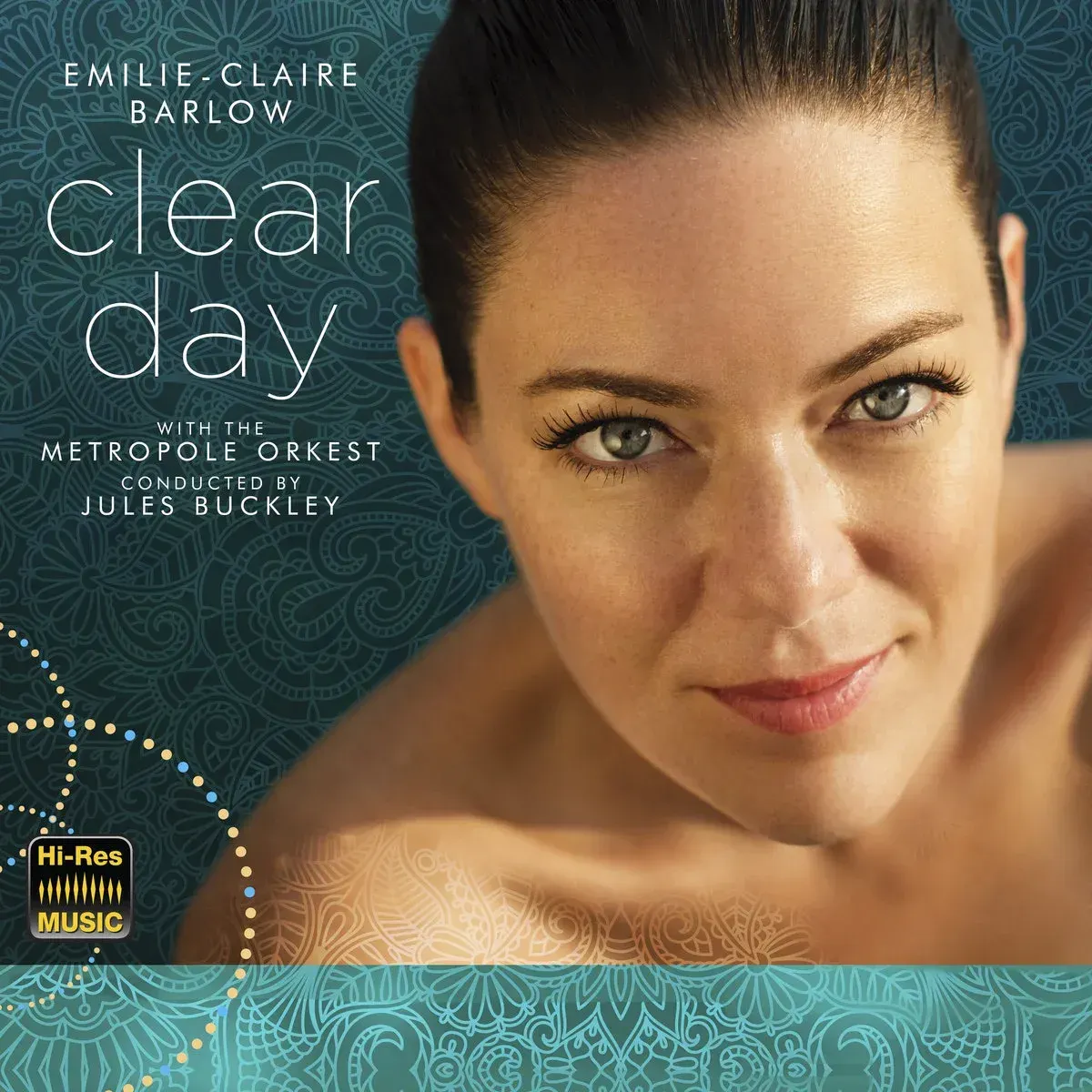
Clear Day — Emilie-Claire Barlow
Clear Day finds Emilie-Claire Barlow confronting a fascinating paradox: the larger the space around her becomes, the more precise her voice must be. Accompanied by the monumental Metropole Orkest, the Canadian singer and arranger creates an album in which orchestral scale is not an embellishment, but an extension of her interpretive language. Strings, brass and woodwinds broaden the horizon of songs drawn from remarkably different worlds without erasing what made them recognizable in the first place.
Recorded across Hilversum, Toronto and Montreal, the album brings together the orchestra conducted by Jules Buckley and a core ensemble featuring Reg Schwager on guitar, Jon Maharaj on bass, Chris Donnelly on piano, Larnell Lewis on drums and Kelly Jefferson on saxophone, clarinet and flute. The coexistence of such a vast orchestral body with an exceptionally agile rhythm section shapes much of the album’s character: Barlow can inhabit the full breadth of an arrangement, then moments later return to the intimacy of a small ensemble.
The repertoire reveals just how elastic that language can be. The Beatles, Coldplay, Van Morrison, Joni Mitchell, Paul Simon, Queen and David Bowie, Brad Mehldau and Pat Metheny coexist within the same journey without turning the album into a mere collection of covers. On “Because,” vocal harmonies and orchestra expand the composition’s stillness; “Fix You” moves from vulnerability toward an almost cinematic scale, while “Feelin’ Groovy” slows the original pulse enough to uncover an entirely different temperature, with Schwager’s guitar inhabiting the space created by this new sense of breath.
Yet it is at the extremes that Clear Day reveals some of its most compelling possibilities. “Unrequited,” by Brad Mehldau, narrows the landscape and exposes how much Barlow can communicate without ever needing to raise her voice. Pat Metheny’s “It’s Just Talk” moves in the opposite direction, toward a more intricate architecture in which melody, rhythm and arrangement seem to shift simultaneously. Somewhere between those two pieces lies much of the album’s identity.
Barlow approaches these songs without nostalgia, nor does she attempt to force them beneath a strict definition of jazz. She listens to them from within, alters their proportions, and finds new places for her voice to inhabit. Clear Day ultimately turns interpretation into an exercise in perspective: songs we thought we knew return to us from another point in the landscape.