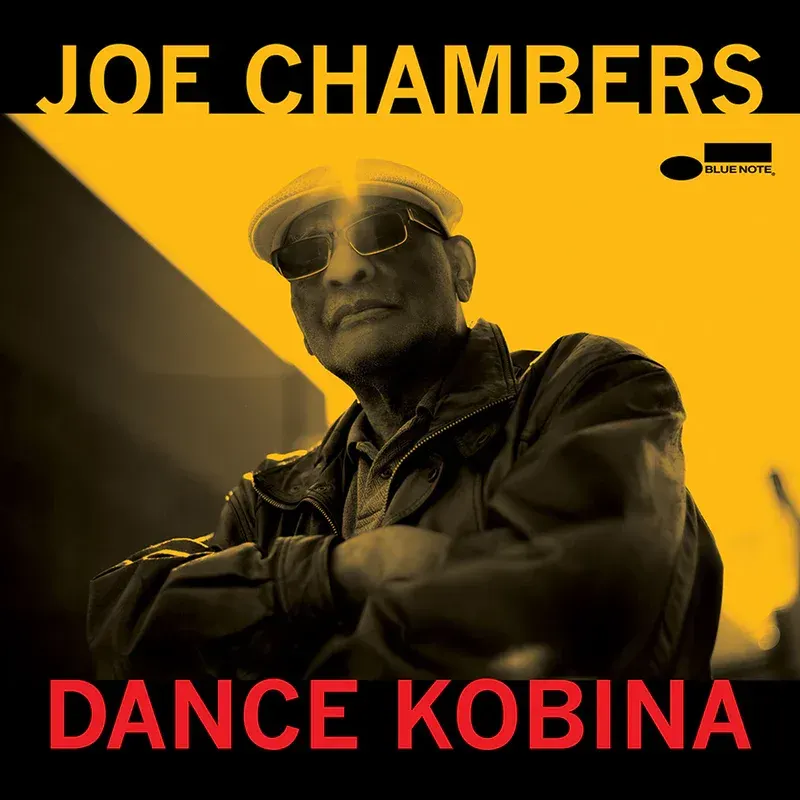
Dance Kobina – Joe Chambers
There is no trace of nostalgia or self-complacency in Joe Chambers' return. Now in his eighties, the drummer and vibraphonist—whose rhythmic signature defined Blue Note’s 1960s masterpieces alongside Shorter, Hutcherson, and Henderson—delivers with Dance Kobina a work pulsing in the absolute present. This third outing as a leader for the blue label serves as a geographical and historical bridge: a recording split between sessions in New York and Montreal, where modal post-bop and the pulse of Afro-Cuban guaguancó merge and reveal themselves as part of the same bloodstream.
The album opens with a New York trio: "This Is New", a Kurt Weill standard that Chambers first recorded in 1966 alongside Chick Corea. Here, joined by Rick Germanson on piano and Mark Lewandowski on double bass, Chambers deconstructs classic swing, injecting subtle Afro-Latin accents that stretch the tempo with astonishing ease.
The contrast arrives immediately with the Montreal session on the title track "Dance Kobina", composed by pianist Andrés Vial. The piece is a polyrhythmic celebration of Central African roots, where the Ngoma drums of Congolese percussionist Elli Miller Maboungou, the alto sax of Caoilainn Power, and the vibraphone of Michael Davidson coexist in a dense, hypnotic, and deeply organic fabric.
Chambers' mastery lies in his refusal to claim the spotlight; he prefers to act as the invisible architect unifying the journey. His original compositions dialogue seamlessly with the past: the gorgeous, subtle ballad "Ruth" (rescued from his album Mirrors) and the fast rumba of "Caravanserai" coexist with "Gazelle Suite", a classic from his 1974 debut (The Almoravid) that here takes on a physical, overflowing dimension through the use of bombos legueros and marimbas.
On Joe Henderson's classic "Power to the People", the New York quintet reaches rhythmic combustion. Chambers drives from the drums and vibraphone while Marvin Carter delivers a gritty, incisive tenor sax solo, sustained by the percussion of Emilio Valdés Cortes. The journey concludes back with the trio on "Moon Dancer", a Karl Ratzer piece in which guaguancó and post-bop swing intertwine almost imperceptibly in Chambers' overdubbed vibraphone.
Dance Kobina does not seek to theorize about the common origin of jazz and ritual music; it simply proves it in every bar, with the lucidity and elegance that only a giant can sustain.