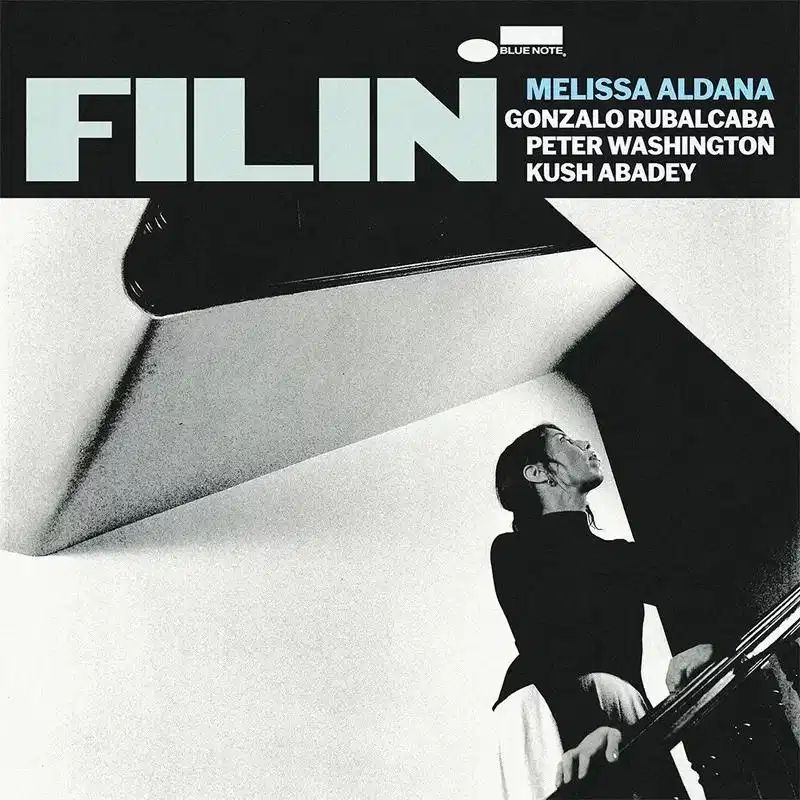
Filin – Melissa Aldana
In Filin by Melissa Aldana, every note is living matter that breathes, expands, and occupies the space with a contained intensity. The project stems from a clear concept —the ballad format— but avoids any predictable gestures.
Instead of resorting to the usual repertoire, Aldana shifts the axis toward Cuban filin, a musical tradition that integrates bolero, trova, and elements of jazz. That decision redefines everything: the phrasing, the relationship with the melody, and the way silence becomes structural.
The core of the album is built alongside Gonzalo Rubalcaba on piano, with Peter Washington and Kush Abadey in the rhythm section, and the precise presence of Cécile McLorin Salvant on vocals. There are no isolated spotlights here: the group functions as an organism moving with an internal logic of extreme precision. The pieces advance with a deliberate, almost suspended slowness. The density does not come from accumulation, but from detail: the way the tenor sax sustains a note, how the piano opens up harmonic space without imposing it, or how the drums, using brushes, redefine the pulse without underlining it.
Everything happens at a minimal threshold, where any variation alters the complete balance. Aldana modifies her approach to improvisation here. Far from extensive harmonic explorations, her discourse becomes melodic, transparent, and concentrated on the internal breathing of each piece. She inhabits the melody from within, letting each phrase find its own weight.
The repertoire —by César Portillo de la Luz, Marta Valdés, José Antonio Méndez, or Cartola— reorganizes itself as a shared territory among bolero, trova, and jazz. Filin is sustained by an idea that is radical in its apparent simplicity: playing less to say more.
The result is an album of tense calm, where every element seems on the verge of disappearing and, precisely because of that, everything acquires an unusual intensity.