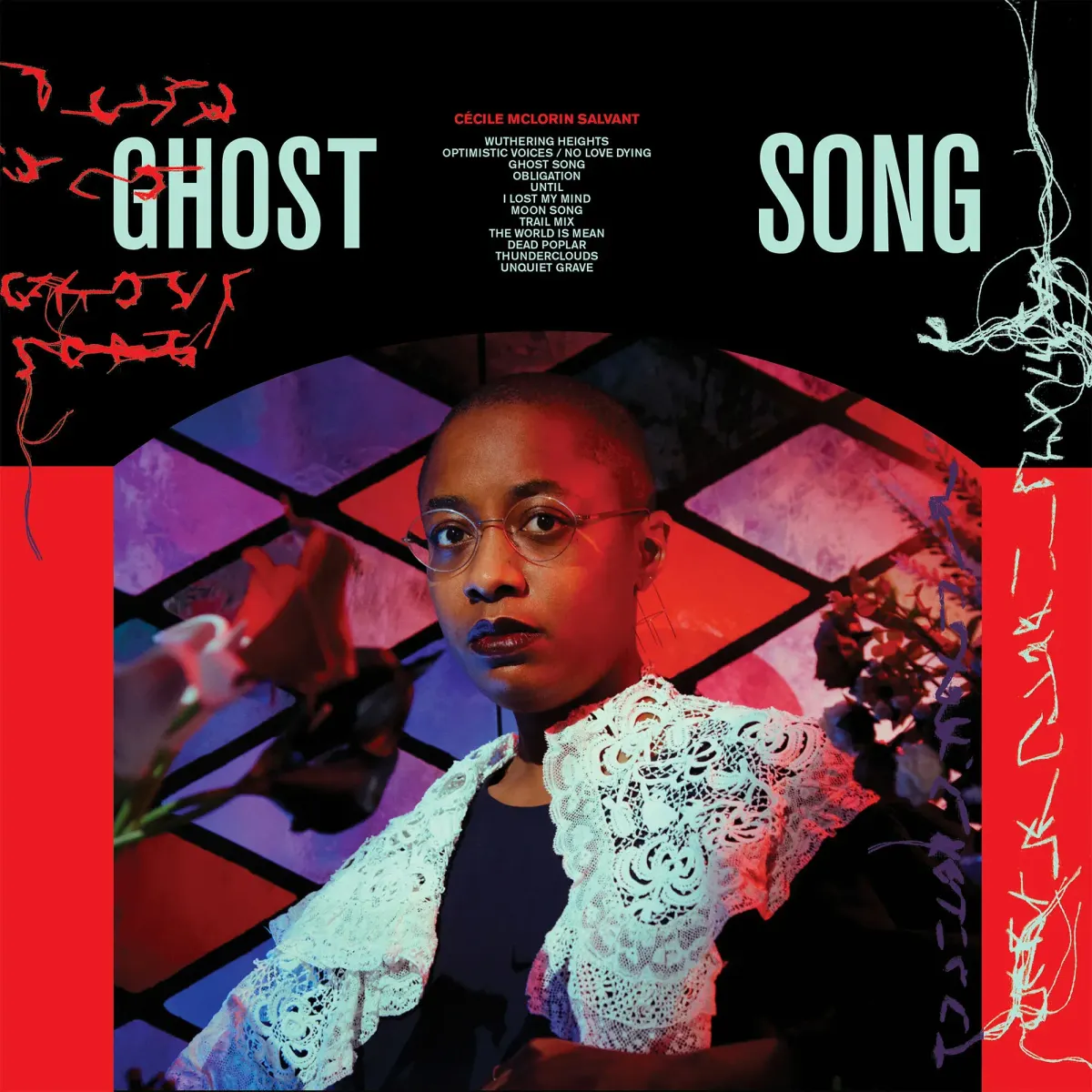
Ghost Song – Cécile McLorin Salvant
In Ghost Song, Cécile McLorin Salvant sings about what remains when something is no longer there. A love ends, a person disappears, reason slips away, or a song belongs to another era, yet nothing disappears completely. Voices return, memories change shape, and desire occupies the space left by what can no longer be reached. Salvant turns that persistence into the inner logic of an album in which each song seems haunted by another.
“Wuthering Heights” establishes that territory from the outset. Salvant takes Kate Bush’s song and begins it almost bare, before Paul Sikivie’s electric bass and synthesizers slowly expand the landscape. From there, she moves through The Wizard of Oz, Gregory Porter, Sting, and Kurt Weill without allowing the breadth of those references to fracture the album. Sullivan Fortner, Aaron Diehl, Alexa Tarantino, Marvin Sewell, James Chirillo, Keita Ogawa, and the rest of the musicians embrace that same freedom: piano, organ, flute, banjo, guitar, percussion, and synthesizers appear and disappear according to what each story requires.
That mobility allows Ghost Song to resist a fixed form. Salvant can move from blues to theater, from balladry to folk, or from acoustic intimacy to strange, almost spectral textures without presenting those languages as exercises in style. On the title track, grief becomes a ritual accompanied by the Brooklyn Youth Chorus; on “I Lost My Mind,” Diehl’s organ and a phrase repeated until it loses its stability transform confusion into a scene of disorientation. These are different decisions born from the same freedom: music does not need to remain static in order to acquire meaning.
That is also why songs written by others cease to function as covers in the conventional sense. Salvant enters them to alter the place from which we hear them, just as she can take a letter from Alfred Stieglitz to Georgia O’Keeffe in “Dead Poplar” and turn private words into song. The past does not appear as an archive that must be preserved intact. It is living material, capable of passing through another voice, another time, and another context to acquire new meanings.
At the beginning, a ghost returns in search of someone still alive; at the end, it is the living who disturb the rest of the dead. Between those two points, Salvant explores different ways of longing for what cannot be possessed: a person, a memory, one’s own stability, even the moon. Desire is born precisely from that distance.
Ghost Song finds its unity there. It is not about a particular genre or a particular way of writing songs, but about the persistence of what refuses to disappear. Cécile McLorin Salvant creates an album inhabited by absences that still have voices, memories that continue to alter the present, and desires whose impossibility makes them no less real. The ghosts remain because there is something worth remembering.