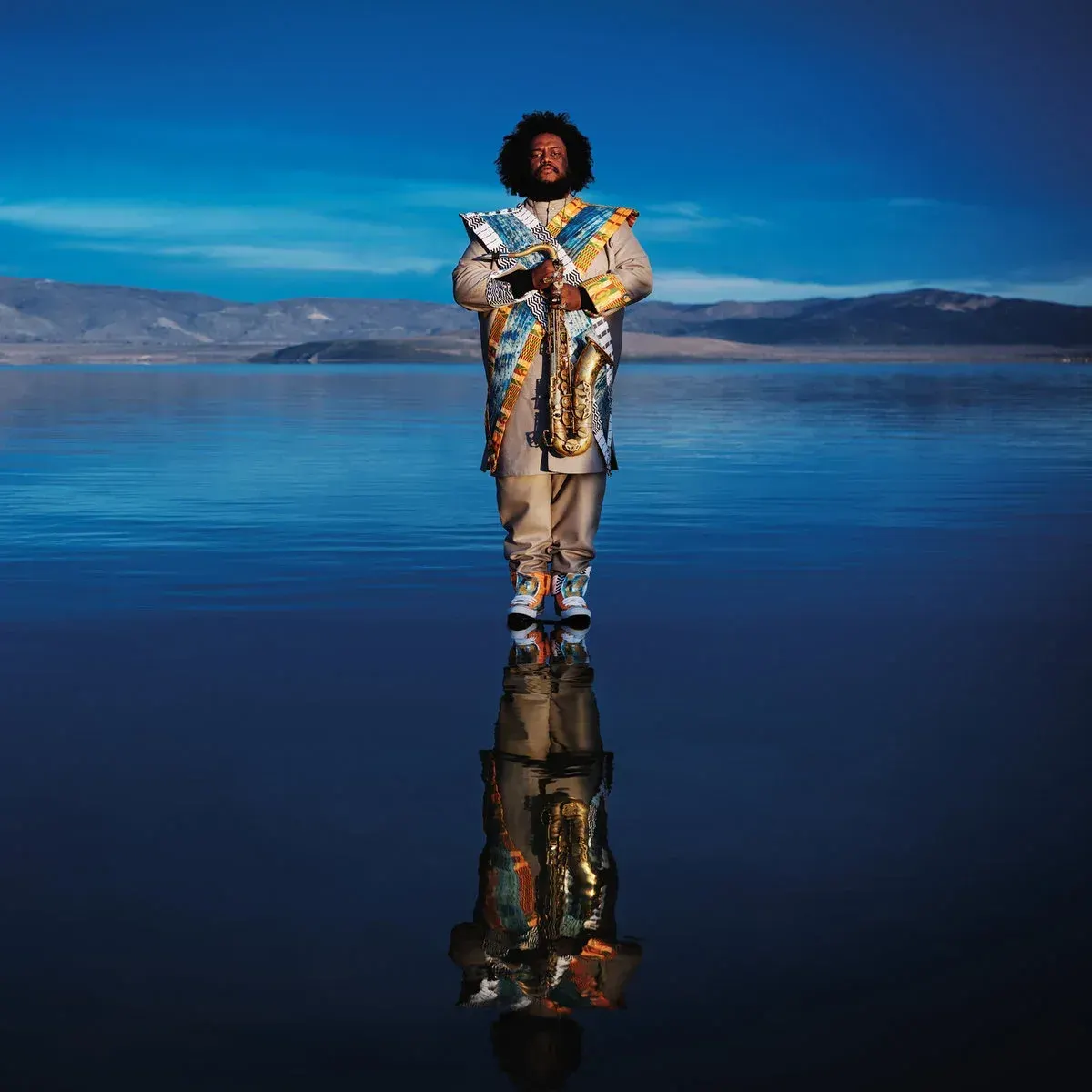
Heaven and Earth – Kamasi Washington
In Heaven and Earth, Kamasi Washington uses monumental scale to ask where identity is formed. Earth looks outward; Heaven, inward. Between these two realms, the saxophonist turns the choir, orchestra, and an expansive community of musicians into parts of a single consciousness, as if understanding the world and understanding oneself were inseparable movements.
“Fists of Fury” establishes this collective dimension from the outset. Washington transforms the theme associated with the Bruce Lee film into a declaration in which the voices of Patrice Quinn and Dwight Trible, the horns, and a foundation threaded with funk and Afro-Latin rhythms move with an almost ceremonial force. The saxophone does not need to rise above this mass of sound: it emerges from within it. Something similar happens in “Hub-Tones,” where trumpeter Freddie Hubbard’s composition retains its post-bop roots while Dontae Winslow’s trumpet and the rest of the ensemble propel it toward the album’s expansive rhythmic language.
The boundary between the earthly and the spiritual begins to dissolve before the first volume has even ended. “One of One” layers percussion, horns, strings, and voices until it creates a sensation of ascent that continues into “The Space Travelers Lullaby.” There, at the beginning of Heaven, the strings and choir move into the foreground. The music seems to hover as Washington transforms what might have been a ballad into a contemplation of the possibility of looking beyond what lies immediately before us.
That impulse coexists with deeply physical elements. Brandon Coleman introduces synthesizers, organ, and vocoder; Miles Mosley, Thundercat, and other bassists reinforce the weight of the groove; while drummers such as Ronald Bruner Jr., Tony Austin, and Robert Searight allow the music to move between jazz, funk, hip-hop, and Afro-Latin pulses. In “Street Fighter Mas,” this relationship reaches one of its most direct expressions: the world of video games enters Washington’s vocabulary without becoming a decorative reference, absorbed instead into music that understands popular culture as part of its own memory.
Toward the end, “The Psalmnist,” composed by trombonist Ryan Porter, shifts the center of gravity. What began as a division between the outer and inner worlds ultimately becomes a shared experience.
This is precisely where Heaven and Earth finds its meaning. Kamasi Washington does not attempt to resolve the tension between these two ideas. He builds a space large enough for them to coexist: tradition and popular culture, body and spirit, individual and community. At the center of it all remains his saxophone, not as the voice of someone who possesses an answer, but as that of someone still searching for wonder.