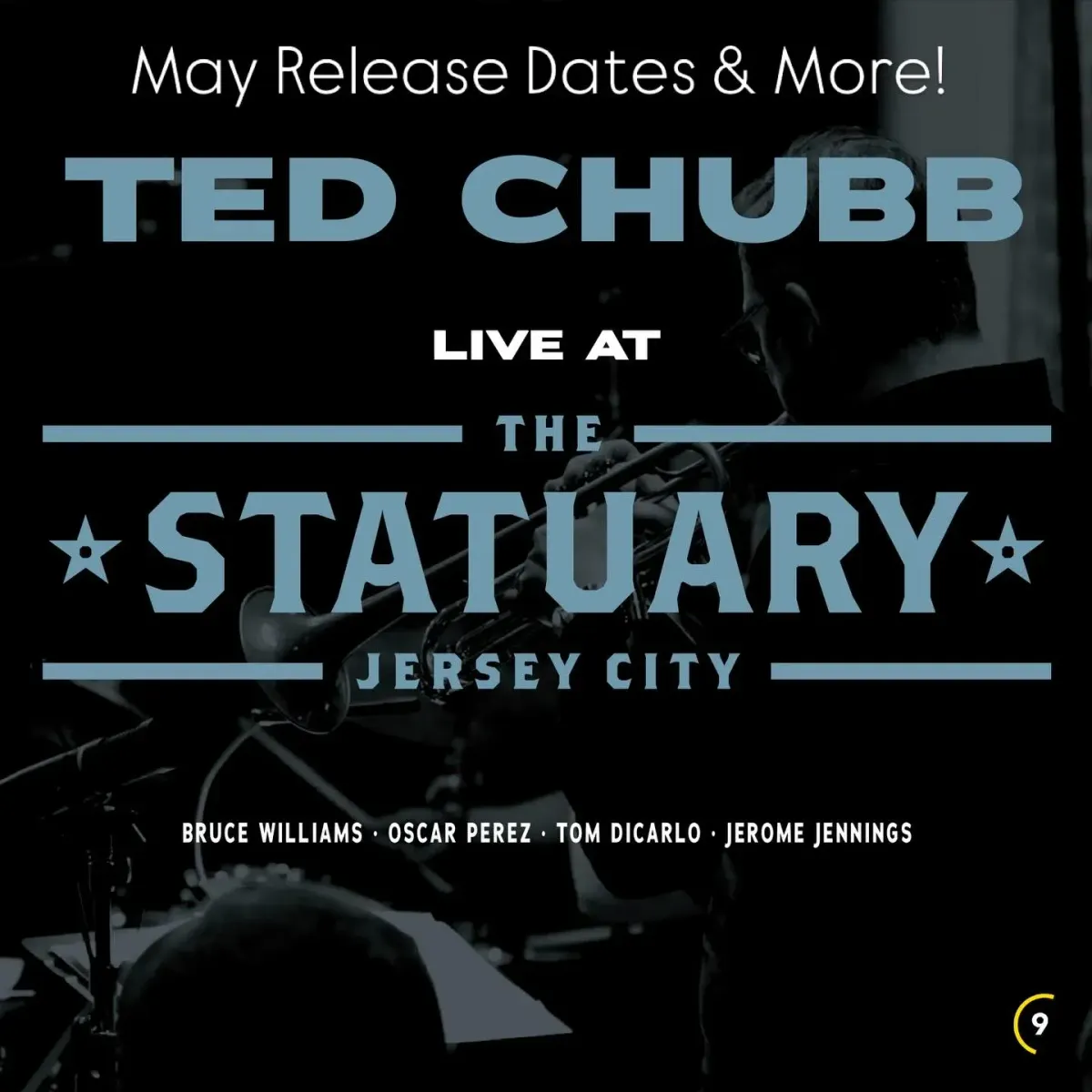
Live at The Statuary – Ted Chubb
Some albums document the resistance and purpose of a space. Live at The Statuary—released by the Circle 9 Records label—is the capture of that absolute closeness. Recorded over four nights in a former 1907 sculpture factory in Jersey City—repurposed into an intimate venue by trumpeter Ted Chubb and his wife Rachel Ryll—, the album dissolves the physical distance between the ensemble and the audience, integrating the room's vibration and the crowd's breath as an additional acoustic and emotional layer of the performance.
At the helm of the quintet, Chubb’s trumpet delivers a mature warmth that eschews empty virtuosity. His phrasing exposes a deeply rooted language connected to the narrative legacy of Booker Little, Art Farmer, and Kenny Dorham; a school of thought where the priority is the clarity of the melody and the honesty of the tone.
The music moves forward with the solidity of those who have shared decades of complicity in the New York scene. Alto saxophonist Bruce Williams serves as an immensely expressive counterweight, and the rhythm section, featuring Oscar Perez on piano and Fender Rhodes, Tom DiCarlo on double bass, and Jerome Jennings on drums, holds the pulse with impeccable flexibility and dynamic rigor.
The repertoire alternates original compositions born from geographical memory and familial roots with reinterpretations of the canon. Pieces like "Expat" and "SBB Bounce" translate the disorientation and movement of his years in Europe into sophisticated swing structures, while "Uptick" shifts the intuition and risk of sailing to the realm of pure improvisation.
The social rawness of "Refugee Hymn" and the mysticism of "Empty Hearts"—a composition by Williams—coexist organically with a poignant version of John Lewis’s "Django," performed with melancholic restraint and absolute precision.
Far from the sterile coldness of a recording studio, this live document is a testament to community and belonging. Ted Chubb does not seek technical perfection, but rather the eloquence of a shared language nurtured by direct encounter. The result is a live, vibrant, and honest album, where jazz reclaims its most primal and transformative function: human dialogue without intermediaries.