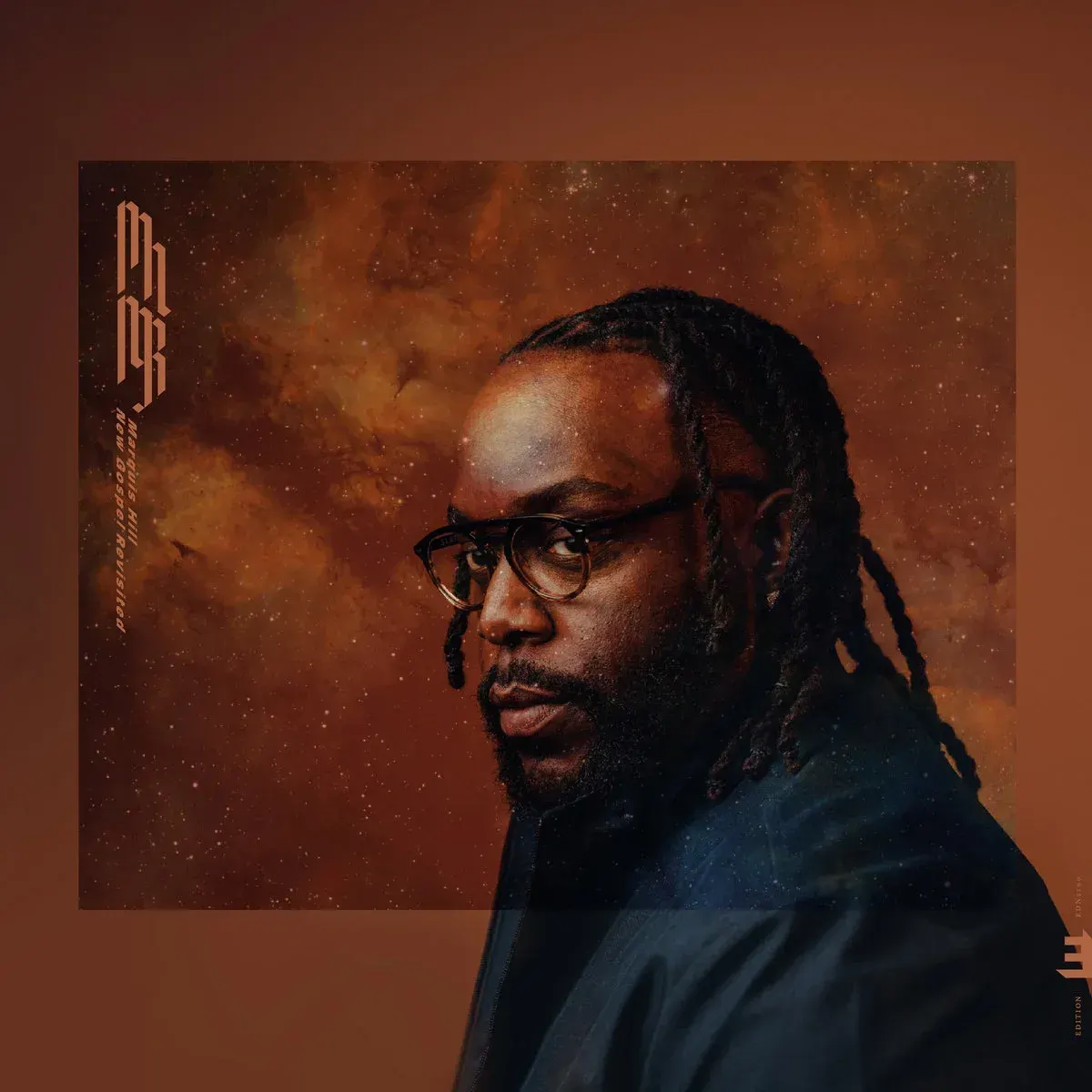
New Gospel Revisited – Marquis Hill
In New Gospel Revisited, trumpeter Marquis Hill returns to the music that launched his career and discovers how much a composition can change when the musician returning to it is no longer the same. Eleven years after releasing New Gospel, Hill revisits that repertoire with a new ensemble and, rather than holding on to a particular sound, allows everything that has happened since to transform its meaning.
Recorded live in Chicago, the sextet brings Hill together with Walter Smith III on tenor saxophone, Joel Ross on vibraphone, James Francies on piano, Harish Raghavan on bass, and Kendrick Scott on drums. “Law & Order” reveals the scale of that encounter. Over more than fourteen minutes, the piece expands into a space of exchanges: Hill’s trumpet opens possibilities that Smith III, Ross, and Francies pursue through different musical languages, while Raghavan and Scott keep the music in motion without reducing rhythm to a fixed structure.
“The Believer” reveals another form of that transformation. Ross and Francies turn vibraphone and piano into a conversation of reflections and contrasts before Smith III extends the journey through the tenor. On “New Gospel,” by contrast, the writing retains a serenity that makes it possible to hear just how much Hill has changed: his trumpet does not need to rise above the sextet in order to lead it; it can remain within the architecture and allow the composition to breathe around it.
“Autumn” carries that openness into more contemplative territory. The melody seems to move suspended above the pulse of Raghavan and Scott, while Ross’s vibraphone introduces a luminosity absent from the original instrumentation. “A Portrait of Fola” reverses that sensation: the interruptions, the tenor attacks, and the almost immediate response of piano, vibraphone, and drums turn the piece into one of the concert’s moments of greatest collective tension.
That is why New Gospel Revisited does not attempt to correct the past or prove how far Marquis Hill has come since his debut. It does something more difficult: it places two moments from the same musical life face to face. The notes were written years ago; those playing them belong to the present. Between the two emerges a music that could only exist after making the journey back.