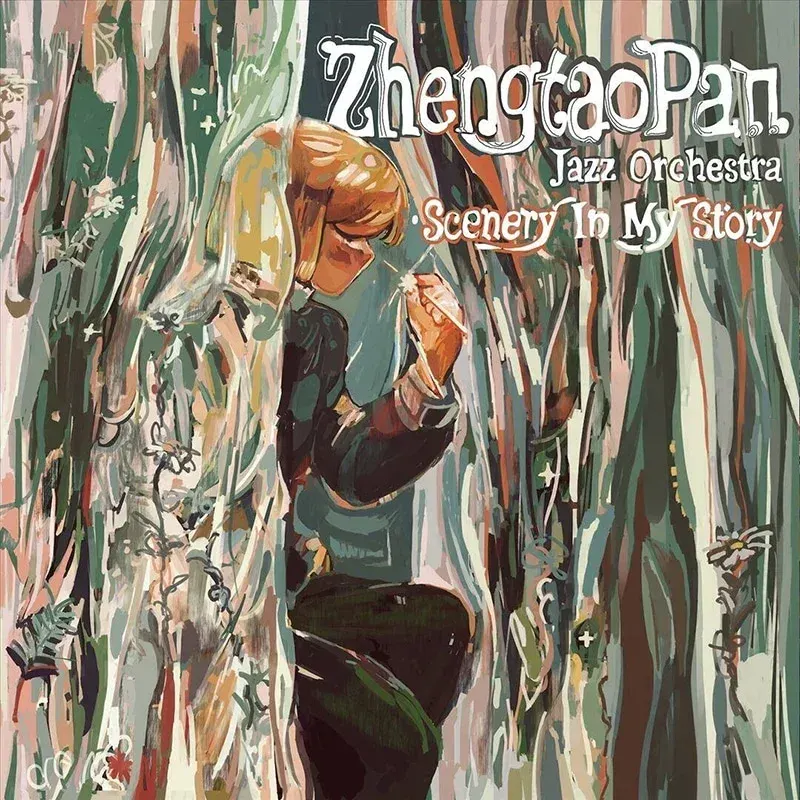
Scenery in My Story – Zhengtao Pan Jazz Orchestra
The debut recording by Zhengtao Pan is a large-scale emotional cartography. Born in Shanghai in 2003, the young composer, arranger, and conductor traces in Scenery in My Story a transoceanic bridge between the memory of his hometown and his immersion in the Boston scene. Far from the academic rigidity that might be expected from his time at Berklee, Pan uses the big band as a malleable narrative organism, where the cinematic textures of his experience scoring video games coexist with the heritage of contemporary jazz.
The album intelligently sidesteps the cliches of traditional swing to venture into a suite of urban and personal vignettes. In the opening track, "Windy Days," Itai Kriss's flute soars over brass harmonies that evoke the coastal breeze shared by both metropolises, sustained by the expansive pulse of drummer Federico Gucciardo. Pan does not hide complexity; he transitions naturally from the folkloric longing of "Hometown,"—where the dialogues between Bob Pilkington's trombone and Nick Frenay's trumpet paint the nostalgia of childhood—to the dense urban friction of "City Machine," a rhythmic and percussive portrait of his first encounter with the machinery of New York.
Collective interaction reaches its highest point when the orchestra places itself at the service of the micro-story. In "Dancing in the Dream," inspired by the resilience of an injured dancer, Walter Smith III's tenor sax and Isamu McGregor's piano build a space that balances between tension and release. That same conceptual elasticity allows Pan to intervene in the classic "It Could Happen to You," stripping it of its habitual romanticism to transform it into a somber abstraction born in the midst of pandemic lockdown, crowned by an incisive alto sax solo by Andrew Gould.
Scenery in My Story concludes with the eponymous title track, an exuberant closing where Pan's own piano and Ross Pederson's drums recapitulate a journey that is as much geographical as it is spiritual. It is a record that impresses not because of the youth of its architect, but because of the lucidity with which it proves that the large orchestra remains an ideal canvas for brutal honesty.