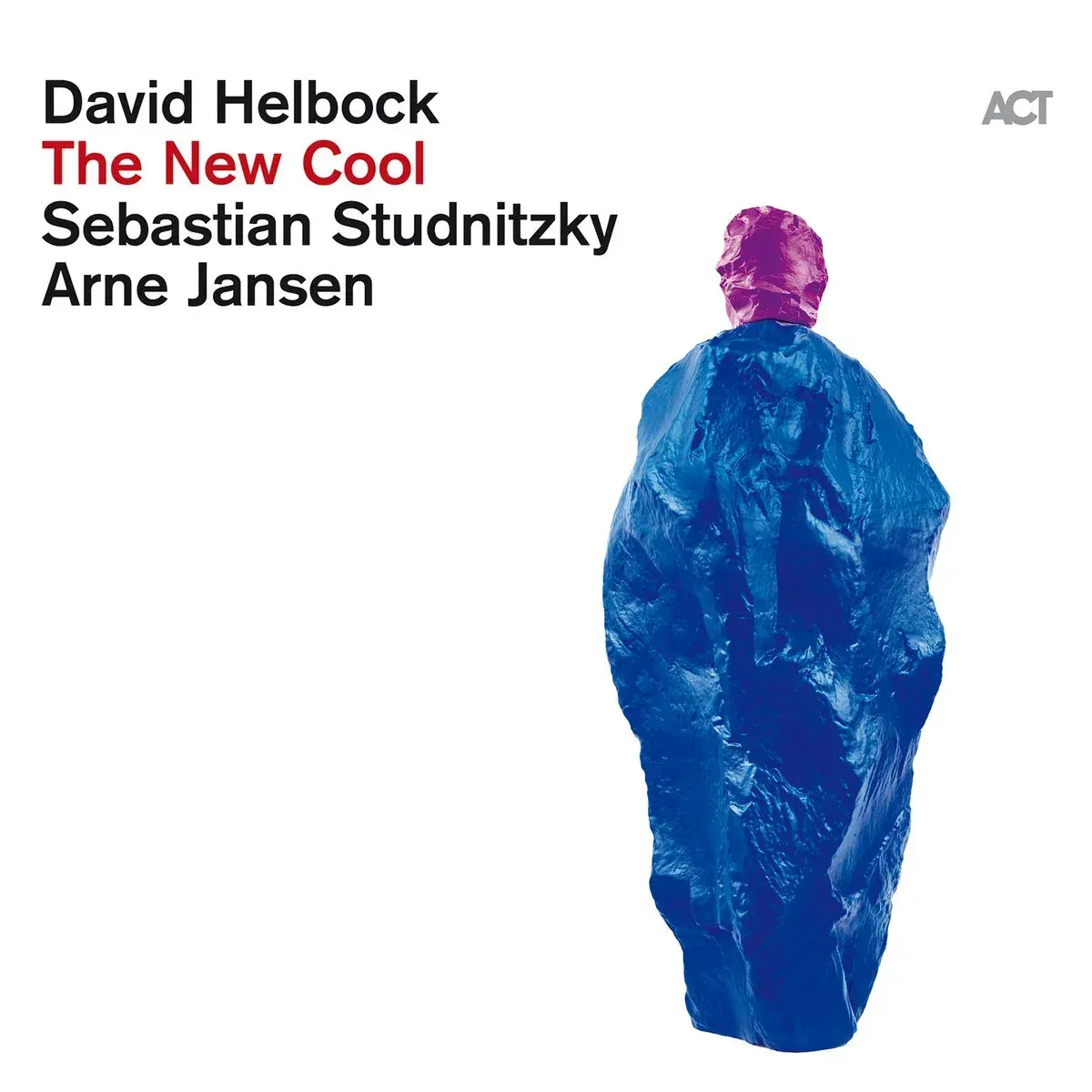
The New Cool – David Helbock
The New Cool begins with an idea of reduction. After projects shaped by instrumental multiplicity and an almost expansive imagination, Austrian pianist David Helbock brings together guitarist Arne Jansen and trumpeter Sebastian Studnitzky to explore what happens when three musicians accustomed to leading choose, first and foremost, to make room for one another. Piano, guitar and trumpet—all occasionally extended through electronics—form a trio without bass or drums, where silence carries as much weight as whatever interrupts it.
The title looks toward the cool jazz of the 1940s and 1950s, but the connection lies less in reproducing its codes than in recovering an attitude: melodic clarity, restraint and close attention to sound. That distance allows material from seemingly incompatible worlds to coexist within the same atmosphere. “I Feel Free,” by Jack Bruce and Pete Brown, sheds Cream’s exuberance and slowly emerges between Helbock’s piano and Studnitzky’s almost spectral trumpet; “Time After Time,” inevitably associated with Cyndi Lauper, relinquishes its pop familiarity and acquires a cinematic darkness.
That ability to alter the memory of a melody is one of the album’s defining strengths. On “I Remember Clifford,” by Benny Golson, the trio preserves the composition’s lyrical dimension while transforming the space around it; Frédéric Chopin’s Prelude in E Minor finds a second life over a minimal piano pulse, surrounded by the breath of the trumpet and Jansen’s sustained electric textures. These interpretations move beyond simple exercises in transformation: they become material absorbed into the trio’s own vocabulary.
The original compositions complete that identity. “Pandemic of Ignorance” moves over a syncopated Helbock figure that seems to accumulate tension without any need to resolve it; “Korona Solitude #1,” by Studnitzky, carries the music into a suspended, contemplative space. On “Truth,” electricity alters the proportions once again, revealing that the calm of The New Cool is far removed from stillness.
Perhaps that is where the album’s true connection to the idea behind its title resides. Cool is not treated as an aesthetic to be reconstructed, but as a way of managing intensity. David Helbock, Arne Jansen and Sebastian Studnitzky can approach Chopin, Cream, Golson or Lauper without needing to reconcile their differences. Everything belongs because the trio has found something more important than a category: a shared way of listening.